
The database is migrating to www.wildcoffeedb.org. Use this site for updated version of the database
The overarching goal of this database is to advance our understanding of wild coffee species, with the ultimate aim of improving their conservation and development.
More specifically, we intend to:
Compile Comprehensive Information: Aggregate information for each species, drawing from both referenced and non-referenced literature, as well as personal observations. This will encompass data on their natural distributions, habitats, morphological features, phenological patterns, biochemical compositions, and genetic/genomic characteristics. The objective is to make this wealth of information accessible through the database.
Specific Presentation of Wild Species: Present each wild species in living collections at the Bassin-Martin and Reunion Island sites, as well as in Kianjavato, Madagascar. This presentation will be accompanied by a photo gallery, providing visual insights into the diverse aspects of these species.
Dedicated Presentation of BaraCoffea Group: Devote a specific section to the wild species belonging to the BaraCoffea group from Madagascar. This focused presentation will offer detailed information about the unique characteristics, distribution, and significance of species within this particular group.
Update: Oct 2024
The 'ex situ' Collections
The Bassin-Martin CRB Collection (Biological Resources Center of Bassin-Martin), La Réunion
The Kianjavato Collection, Madagascar
The Mahajanga Collection, Madagascar
DetailsList of Coffea species
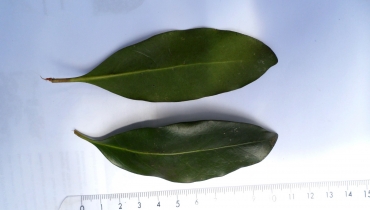
C. mangoroensis Portères Mascarocoffea NEAR THREATENED
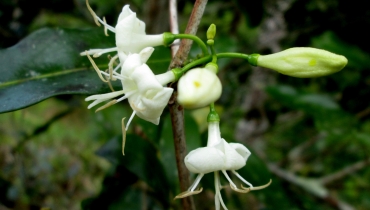
C. mangoroensis Portères Mascarocoffea NEAR THREATENED
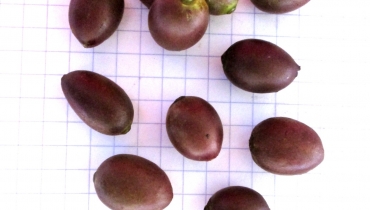
C. mangoroensis Portères Mascarocoffea NEAR THREATENED
The Specific Case of Psilanthus Species:
Coffee trees (Coffea genus) are woody plants belonging to the Rubiaceae family. Within this family and, in particular, the Coffeeae tribe, the position of the genus Psilanthus appears problematic because for a long time, it was considered as "false coffee trees." Consequently, they are nearly absent from the world's main living collections. Psilanthus, present on the African continent, Asia (India, Sri Lanka, tropical and South-East Asia), and Oceania (Northern Australia) but absent from the islands of the West Indian Ocean (Madagascar, Mascarenes, and Comoros), constitutes the closest phylogenetic group to Coffea (Robbrecht and Manen, 2006). Its status, established by Hooker (1873), confirmed by Chevalier (1947) and Leroy (1981), accepted by Stoffelen (1998), Khumar et al. (2008), has been refuted by Davis et al (2011). Thus, according to the latter proposition, coffee trees are represented by the 103 species of the genus Coffea (including the group of Baracoffea, endemic to the west coast of Madagascar) and the 21 Psilanthus species (see distribution map for each species); the new genus being called Coffea (introducing a possible source of confusion). In this database, we decide to present the species as before Davis et al (2011), but with the new name as synonyms to avoid any source of confusion. This doesn’t mean indeed that the proposition of Davis et al (2011) was refuted here.
Coffea: Multiple Sources of Name Confusions:
Another source of confusion is the justified or unjustified acceptance of synonymies. While it is generally accepted that Psilanthus minor is, in fact, P. sapinii or that Coffea vaughanii is C. myrtifolia, the synonymies of some Malagasy species reported in Davis et al (2006) remain problematic. However, these species appear under their original name in living collections and in various works. To avoid any confusion, we have chosen here to list all the species that have been described, to indicate synonymies where they exist and to treat all species individually. In addition, some species collected in the 1980s (Anthony et al. 1985, de Namur et al. 1987) have still not been described although they have been the subject of morphological and genetic studies (Bontems, 1990; Groell 1991, Baranski 1997, Hamon et al. 2017; Guyeux et al., 2019). They are maintained in the living collections of Côte d'Ivoire and Reunion Island. Finally, if 124 species were formally identified, 141 taxa could be taken into account (Couturon et al. 2016) and considered here. Most of these species are outcrossing species, with the exception of C. arabica (self-compatible and mostly self-fertilization), C. anthonyi, and C. heterocalyx for Coffea strictu-sensi and two species in the Psilanthus group.
Protection Needs for Coffea Species:
Davis et al (2006), considering only the "ex-Coffea" species, classified 14 (8 Malagasy and 6 African) as almost endangered, 23 as vulnerable (8 Malagasy, 2 Mauritian, and 13 African), 38 as endangered (30 Malagasy, 2 Mauritian, and 6 African), and 19 as seriously threatened (12 Malagasy and 7 African). There is no doubt that 12 years later, this observation has only worsened (Davis et al., 2019). Another observation concerns the protection of these species. The three largest living collections of wild coffee trees contain only 54.6% of the species. Two of these ex situ collections (located in the research station of the Centre National de Recherche en Agronomie de Divo, Côte d'Ivoire, and the Centre de Ressources Biologiques (CRB) of Bassin-Martin in Reunion Island are almost redundant in terms of the wealth of African species. However, the CRB in Bassin-Martin stands out from the others due to the presence of species collected in Reunion Island, Mauritius, and Mayotte by E. Couturon and collaborators in 2010. The third, located in the research station of the National Centre for Applied Research for Rural Development (FOFIFA) in Kianjavato, Madagascar, is unique. It includes the majority of Madagascar's endemic species with the exception of species (ex Baracoffea) endemic to the west coast of Madagascar. These species remain outside of any ex-situ collection.
DetailsReferences

How to use this web site
To search for a species in the Coffee Species database, you have two primary methods:
General Species Table:
- Navigate to the "Species" web page.
- The general species table is displayed in alphabetical order.
- Browse through the table to find information on various species.
Search Option:
- On the left side of the "Species" web page, use the search option for a more specific single species search.
- Enter criteria such as Species names, Section, presence in living collection, or species name synonymy.
Upon obtaining search results, the information is presented in three panels on the Result page:
Detail Table:
- Species: Taxonomy (accepted name)
- Section: Mozambicoffea / Eucoffea / Mascarocoffea / Psialthis Africa / Psilanthus Asia
- Presence in living collection (BassinMartin or Kianjavato)
- IUCN red list
- Global Biodiversity Information Facility: Direct link to the species
- Synonymy (species name): synonymy or formal temporary name (IRD)
- Reference publication: Publication of species description
- Literature proposed in Davis et al., 2006: Additional reference for general information about the species (From Davis et al., 2006)
- Distribution: Geographic distribution
- Habitat/Ecology: Ecology of the species
- Caffeine content in beans (% dmb): extracted data from literature
- Caffeine content in leaves (% dmb) extracted data from literature
- Trigonelline (% dmb) extracted data from literature
- ACG (% dmb) extracted data from literature
- Sucrose (% dmb) extracted data from literature
- Mangiferin content in beans (unpublished data)
- Mangiferin content in leaves (% dry weight): extracted data from literature
- Ripening time in months: Data from Malagasy species
- Reference ripening for species not in collection
- Ripen fruits color
- Foliar dimensions in cm
- Pollen pictures (New)
- Genome size (Mbp) 1C
- References for genome size
- Genotyping by sequencing data: Data from Hamon et al., 2017. Access to the Dryad site for downloading
- Illumina sequencing data (length, amount of data): Sequenced species using Illumina. Not public but available upon request.
- Chloroplast complete genomes: Availability of complete chloroplast genome. Guyeux et al., 2019; Charr et al. 2020.
- Complete nuclear genomes: Available complete nuclear genomes.
- Other information
Geographical Map:
- A geographical map is provided, highlighting the proposed distribution of the species.
Photo Gallery:
- A photo gallery showcases different views of the species, including whole trees, leaves, flowers, fruits, etc.
How to Download data
The data from this site can be downloaded using the following links:
High-Quality Photos:
- Dataverse IRD
- https://doi.org/10.23708/JZA8I2
Chloroplast Genome Sequences:
- Dataverse IRD
- https://doi.org/10.23708/KWRIJJ
Text Tables and Internal Links:
Warning: Conditions of Use of Pictures on this Site:
- This work is licensed under a Creative Commons Attribution-NonCommercial-NoDerivatives 4.0 International License.
- Attribution: You must give appropriate credit, provide a link to the license, and indicate if changes were made. This should be done in a reasonable manner, without suggesting the licensor endorses you or your use.
- Non-Commercial: The material cannot be used for commercial purposes.
- No Derivatives: If you remix, transform, or build upon the material, you may not distribute the modified material.
Citation Requirements:
- The DOI and the copyrights must be cited in any publications or websites using this dataset.
- Reference the scientific publication: Guyot et al., 2020 Database.
Use of Image Set on Another Website:
- For the use of the image set on another website, it is strongly recommended to contact the authors of the database and pictures.
Unpublished Genomic Data:
- The availability of unpublished genomic data may be examined upon request.